
Soft pouches and "insulated lunch bags" lose the cold fight in about 4 hours. For real peptide travel — multi-day road trips, long-haul flights, cruise embarkation, RV trips — you need a hard-shell cooler with rotomolded walls and ice retention measured in days, not hours.
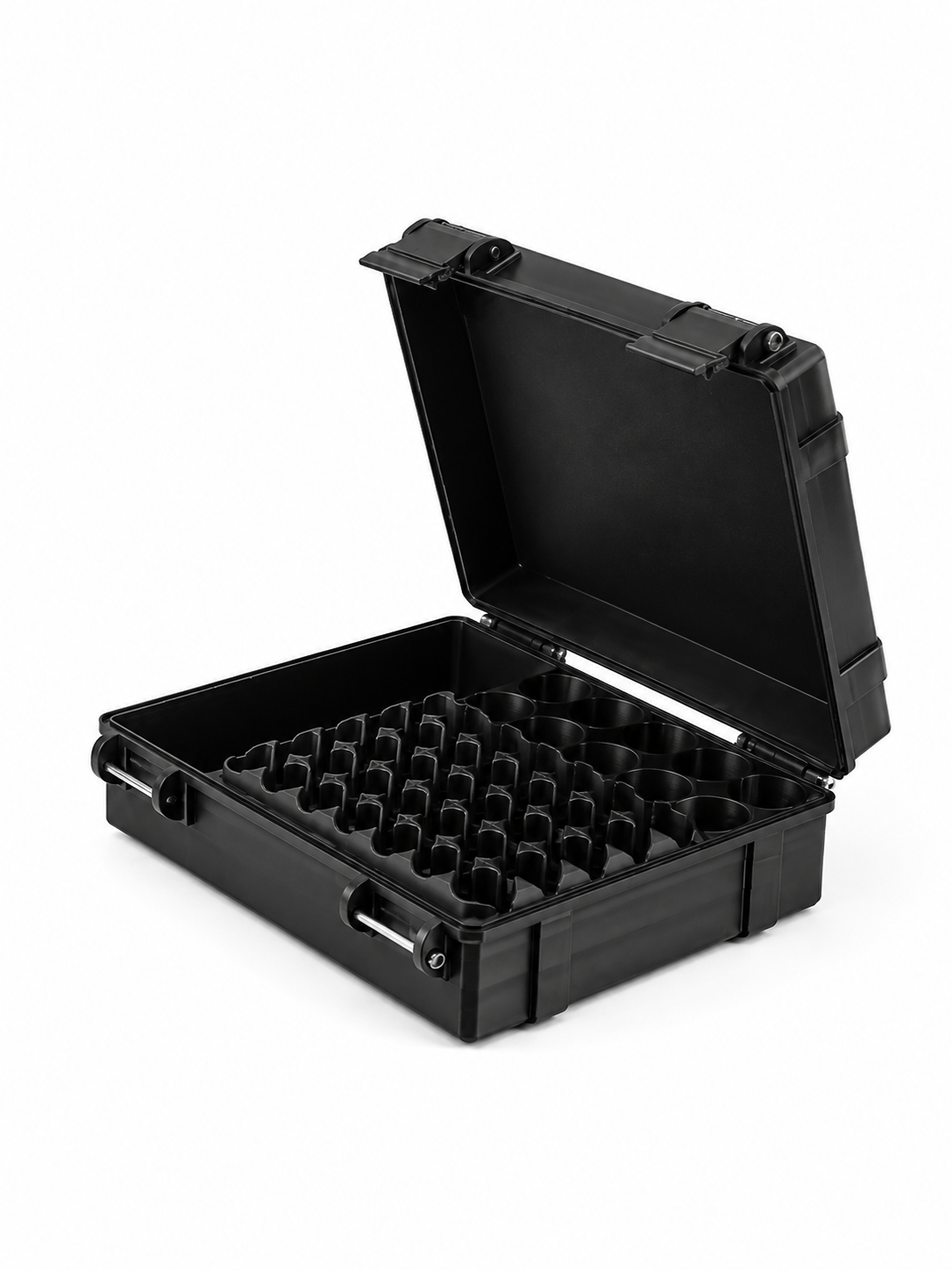
Five hard coolers below, all rated for 48+ hours of ice retention, ranked for peptide travel specifically. We're looking at how a vial case fits inside, the temperature curve over 72 hours, and which size is right for which trip.
Why a hard-shell cooler matters for peptides
Peptides degrade above 8 °C. Even a 4-hour stretch at room temperature accelerates loss. A rotomolded hard cooler with 2 inches of polyurethane precision-cut and a freezer-grade gasket can hold 32–40 °F for 48–96 hours with the right ice pack ratio. That's the difference between a destination arrival with usable medication and one with a $400 brick of degraded protein.
Look for:
- Rotomolded construction — one-piece molded shell, not seamed plastic.
- Pressure-fit gasket — the lid seals airtight, not just "closes."
- Latch locks — keeps the lid pressed against the gasket; flip-tops alone don't seal tight.
- Interior dim that fits your case — measure your vial case and the cooler interior in advance.
The 5 coolers, ranked
1. Best overall — Yeti Roadie 24
Rotomolded, 18 lb empty, 22 qt capacity. Ice retention: 5+ days with 2:1 ice-to-content ratio. Fits a Vial Vault Pro 56 + two phase-change packs comfortably. Carry handle plus optional shoulder strap. ~$250.
The Yeti tax is real, but the Roadie 24 is the gold standard for medical-grade peptide travel because it actually performs to spec. Two-day road trip, three-day cruise embarkation, week of camping — it holds.
Shop Yeti Roadie 24 on Amazon Prime →
2. Best value — RTIC 20 Hard Cooler
Same rotomolded construction as Yeti, 1/3 less money. 20 qt, 16 lb empty, 5+ day ice retention. The only meaningful difference is the latch — Yeti's is rubber, RTIC's is plastic. Both seal fine. ~$120.
If you're not brand-loyal, RTIC saves enough for two extra months of peptide supply. Same interior space as the Roadie 24.
Shop RTIC 20 on Amazon Prime →
3. Best small-trip — Igloo BMX 25
Rotomolded, 25 qt, 14 lb empty. 4-day ice retention. The rubberized handles and rubber feet keep it stable in a moving vehicle. ~$110.
For weekend trips or carry-on size (just under TSA carry-on dimensions in some airlines), the Igloo BMX is the right scale. Fits a small vial case + 4 lbs of ice + a few drinks.
Shop Igloo BMX 25 on Amazon Prime →
4. Best premium — Pelican 20QT Elite
Made by the same company that builds drone cases for the military. 10-year warranty, indestructible, 7+ day ice retention. Press-and-pull latches that won't fail. ~$280.
Overkill for a weekend, perfect for international travel where checked luggage might bake on a tarmac in Dubai for 6 hours. Built like a tank.
Shop Pelican Elite on Amazon Prime →
5. Best soft-sided exception — Yeti Hopper Flip 12
Not technically hard-shell, but the only soft cooler with verified medical-travel ice retention. 12L capacity, 3-day ice life with phase-change packs. Strap-friendly for plane carry-on. ~$200.
When you need TSA carry-on compliance + cold for 2–3 days, the Hopper Flip is the answer. Fits a Pro Max 45 or smaller plus 2 phase-change packs.
Shop Yeti Hopper Flip 12 on Amazon Prime →
Quick comparison
| Cooler | Capacity | Ice life | Price |
|---|---|---|---|
| Yeti Roadie 24 | 22 qt | 5+ days | $250 |
| RTIC 20 | 20 qt | 5+ days | $120 |
| Igloo BMX 25 | 25 qt | 4 days | $110 |
| Pelican 20QT Elite | 20 qt | 7+ days | $280 |
| Yeti Hopper Flip 12 | 12 L | 3 days | $200 |
Packing a cooler for peptide travel
- Pre-chill the cooler 12 hours with sacrificial ice before loading. A warm cooler interior eats 50% of your ice budget in the first 2 hours.
- Use phase-change packs, not just ice. They stay at a designed temperature (e.g., 5 °C) instead of melting straight through.
- Wrap vials in a hard-shell case like the Vial Vault Pro Max. Direct ice contact can freeze peptides — game over.
- Layer: ice/packs on bottom, vial case on top of insulating layer (towel or precision-cut pad), more packs around the case.
- Open as little as possible. Every door open burns 30+ minutes of ice life.
TSA + airline notes
Hard coolers fly. Phase-change packs fly (must be frozen solid at security or treated as gel). For carry-on, the Igloo BMX 25 and Yeti Hopper Flip 12 fit most airline overhead bins. The Roadie 24 and RTIC 20 are typically checked. Pelican 20QT Elite — always checked.
Full TSA breakdown: TSA Airport Rules for Peptides.
Related reading
- Best TSA Travel Coolers for GLP-1
- Cold Pack Comparison: Gel vs Phase-Change vs Dry Ice
- How to Keep Peptides Cold During Summer Travel
Frequently Asked Questions
Is a Yeti really worth the premium over an RTIC?
For ice retention, no — RTIC matches Yeti within 1–2 hours on a 5-day hold. The Yeti has slightly better latch construction and resale value. For peptide travel specifically, save the difference and pair an RTIC 20 with phase-change packs.
Can I take a hard cooler as airline carry-on?
Most airlines allow soft-sided coolers as carry-on (Yeti Hopper Flip 12) and require hard-shell coolers (Roadie 24, RTIC 20, Pelican Elite) to be checked. Confirm with your specific airline before flying. Always carry medical documentation.
How many ice packs do I need for a 48-hour trip?
Roughly 2 lbs of ice or 2 large phase-change packs per cubic foot of cooler space. For a Yeti Roadie 24 (22 qt ≈ 0.7 cu ft) on a 48-hour trip, that's 4 lbs of phase-change packs (two 32-oz +5 °C units).
Will phase-change packs freeze my vials?
They can if vials touch the packs directly. Always wrap vials in a hard-shell case (like Vial Vault Pro Max) before placing them inside the cooler. The case provides 5–8 mm of thermal buffer between the vials and the cold source.
Do I need to pre-chill the cooler?
Yes. Pre-chilling 12 hours before loading with sacrificial ice ensures the cooler interior starts at 32 °F instead of room temperature. A warm interior burns through 50% of your ice budget in the first 2 hours of the trip.
What temperature logger works inside a hard cooler?
Bluetooth loggers (Govee, SensorPush) work as long as you can pair with your phone before sealing the cooler. WiFi loggers won't work — no signal inside. A case with built-in sensor (TempView) is the simplest option since it stays paired with the case wherever it goes.
Affiliate disclosure: VialCase is a participant in the Amazon Services LLC Associates Program. As an Amazon Associate, VialCase earns from qualifying purchases at no additional cost to you. Trademarks: All brand names and product names referenced (including but not limited to Ozempic®, Wegovy®, Mounjaro®, Zepbound®, and any device or supplement brand mentioned) are the property of their respective owners and are used here for editorial identification only. VialCase is not affiliated with, endorsed by, or sponsored by these brands.
Educational only. Always carry a temperature logger for any trip over 24 hours.


