Cold-Storage & Organization Guide for Research Materials in Liquid or Solid Form (2026)
Updated on: 2026-05-08
Cold-Storage & Organization Guide for Research Materials in Liquid or Solid Form (2026)
This article is for general informational, storage, and organization purposes only. It is not medical advice and contains no instructions for preparing, dosing, or administering any medication. VialCase sells storage cases and accessories — not medications, peptides, GLP-1 drugs, or research chemicals. Always follow your licensed healthcare provider's and the product manufacturer's instructions.
If you keep labeled research materials on a shelf, in a fridge, or in transit, most of the headaches you run into are storage and logistics problems — light exposure, the wrong temperature band, humidity, leaking caps, and disorganized bottles that get mixed up. This guide focuses entirely on the neutral side of that work: how to keep containers physically protected, organized, temperature-stable, and ready to move, using the right cases and accessories.
Nothing here is a use, preparation, or handling guide for any substance. It is a storage-and-organization reference for the containers themselves, framed around the four environmental variables that actually determine whether a labeled sample stays physically intact in storage: light, temperature, humidity, and air exposure.
Table of Contents
- Liquid vs solid samples: storage differs
- Light, temperature & air: the big three storage variables
- Why some liquids are more storage-sensitive than others
- Humidity and solid-form storage
- Travel & cold-chain logistics
- Storage equipment for long timelines
- FAQ
- Disclaimer
1) Liquid vs solid samples: storage differs
Labeled research materials generally arrive in one of two physical formats, and the storage profiles diverge significantly.
- Liquid bottles — typically supplied in amber dropper bottles. More sensitive to temperature swings, light, and air exposure than solid form, and more prone to changes in clarity if stored in the wrong temperature band.
- Capsules and powders — solid forms are generally more physically stable but more vulnerable to humidity ingress, settling, and softening of gelatin shells.
The most common storage mistake is treating liquid bottles the same way as solid containers. They are not equivalent storage platforms, and a case or cooler that suits one may not suit the other.
2) Light, temperature & air: the big three storage variables
Three environmental variables drive most physical changes seen in stored liquid bottles. Controlling them is purely a storage-and-organization task.
- Light. UV is the most aggressive driver of change. Direct sunlight is obvious; less obvious is fluorescent overhead lighting. A common organization practice is keeping amber bottles inside opaque storage cases — double light protection. Clear glass on an open shelf is the worst configuration.
- Temperature. Many liquid bottles do best in a stable cool room-temperature band rather than a cold kitchen fridge, which can cause solids to come out of suspension. Heat is also undesirable. A wine fridge held in a moderate band is a common, easily controlled setup; a stable environment without swings matters more than any single number.
- Air exposure. Each time a bottle is opened, fresh air enters. A common organization practice is to keep a master bottle sealed in storage and minimize how often it is opened.
⚠️ Freezing liquid bottles: Freezing liquid bottles is widely reported to cause permanent physical change to the contents. Keeping liquid bottles above freezing in a stable cool band is the common storage practice; very cold storage is generally reserved for sealed solid samples. Follow the manufacturer's storage label.
3) Why some liquids are more storage-sensitive than others
Different liquid bottles tolerate storage conditions differently depending on how they are formulated. From a purely physical, storage-organization standpoint, the practical takeaways are:
- Some liquids change clarity quickly if stored too cold, and a stable cool band is more forgiving than a cold fridge.
- Some carriers can slowly lose volume through dropper-cap leakage over months, which is why upright storage and a sealed master bottle matter.
- Empirical observation over the first 30 days is the most reliable predictor of how a given bottle will behave in long-term storage.
None of this requires opening or handling the contents — it is about choosing a storage temperature band, keeping bottles upright and sealed, and protecting them from light.
4) Humidity and solid-form storage
Solid forms — capsules and powders — are generally more physically stable than liquids but are vulnerable to ambient humidity. Common organization practices:
- Desiccant packets in capsule containers. Silica gel (replaced periodically) helps prevent gelatin-shell softening and clumping.
- Sealed containers kept at stable room temperature in a dry location.
- Date-marking each container with receipt date and a projected rotation date.
5) Travel & cold-chain logistics
Moving temperature-sensitive containers is a logistics problem. General factual pointers:
- TSA / airline rules. Check current TSA guidance and your airline's policy for carrying medically necessary items and cooling materials; rules on gel packs and the state they must be in (e.g., frozen solid) change, so verify before you fly.
- Cruise and customs. Cruise lines and international customs have their own declaration and storage rules. Confirm in advance and carry manufacturer documentation.
- Cold packs and coolers. A small insulated case with cold packs maintains a stable band for short trips. For longer trips, plan a re-chill point.
- Power-loss backup. For fridge or wine-cabinet storage, a battery or backup plan protects against outages; pre-frozen cold packs in the cabinet buy time during a short power loss.
🧪 Light-blocking storage cases
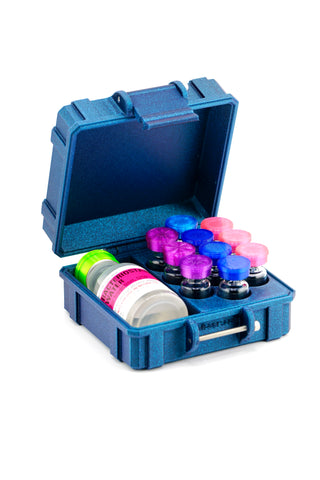
UV exposure is a leading cause of physical change in stored liquid bottles. A hard-shell, light-blocking case with cold-storage compartments protects bottles through long storage timelines and travel.
6) Storage equipment for long timelines
Storage timelines frequently run 12–24 months from purchase. Equipment that supports that timeline:
- Light-blocking hard-shell cases. Opaque cases protect amber bottles from incidental UV and provide structural protection against drops — the most cost-effective protection for liquid bottles.
- Wine fridge or peltier-cooled cabinet. Maintains a stable, moderate cool band rather than a cold fridge.
- Desiccant packets in solid-form containers. Silica gel (replaced periodically) prevents shell softening and clumping.
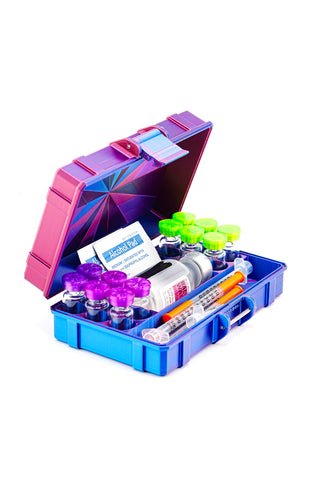
- Multi-slot organizers. Organized multi-slot storage prevents containers from getting mixed up. The same vial cases used for other small bottles transfer directly.
- Date-marking and rotation. Mark each bottle with receipt date and projected rotation date; rotate oldest-first.
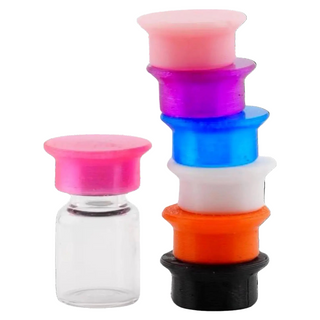
For multi-container organization, see the research storage organization reference — multi-slot organization and color-coded caps apply broadly. For temperature-controlled equipment, see the bulk storage reference. The long-timeline storage reference covers the same multi-month storage challenge.
7) FAQ
What temperature band is best for liquid bottles in storage?
Many liquid bottles do best in a stable, moderate cool band rather than a cold kitchen fridge, which can cause solids to come out of suspension. The general organization rule is cool but not cold, dark, sealed, and upright. Always follow the manufacturer's storage label.
Can I freeze liquid bottles to extend storage life?
Freezing liquid bottles is widely reported to cause permanent physical change. The common practice is to keep liquid bottles in a stable cool band above freezing; very cold storage is generally reserved for sealed solid samples. Follow the manufacturer's instructions.
Why does a liquid bottle turn cloudy or discolored in storage?
Cloudiness, haze, or discoloration are common visual indicators that something in the bottle has physically changed in storage — often linked to temperature, light, or age. From a storage standpoint, these are signals to set the bottle aside per the manufacturer's guidance rather than a sign of how to use it.
Do solid-form containers need refrigeration?
Solid forms are generally stable at stable room temperature in a sealed container with desiccant. Follow the storage label on the product; refrigeration is not always necessary and is not a substitute for keeping humidity out.
How should I organize a mixed fridge of temperature-sensitive containers?
Group containers by their required temperature band and keep them in labeled, dated multi-slot organizers to avoid mix-ups. Multi-zone fridges or a separate wine fridge help when different containers need different bands. Position warmer-tolerant containers on the door and colder-band items on interior shelves, per each product's storage label.
Should I keep bottles in the original container?
Yes — the original amber bottle is typically engineered for the contents and is usually the best container available. Keep it upright, sealed, and inside an opaque hard-shell case for light protection. Avoid clear glass on an open shelf.
What should I check before traveling with temperature-sensitive containers?
Verify current TSA, airline, cruise, and customs rules for cooling materials and medically necessary items before you travel; carry manufacturer documentation. Pack containers in an insulated case with cold packs and plan a re-chill point for longer trips. For cold-pack supplies, see the storage supplies referenced below and the visual-indicators storage reference.
Trademark notice: VialCase is independent and is not affiliated with any manufacturer, research-supply vendor, or compounding pharmacy. This article is a storage-and-organization reference for containers and accessories only.
Disclaimer
This article is for general informational, storage, and organization purposes only. It is not medical advice and contains no instructions for preparing, dosing, or administering any medication. VialCase sells storage cases and accessories — not medications, peptides, GLP-1 drugs, or research chemicals. Always follow your licensed healthcare provider's and the product manufacturer's instructions.
Find your perfect case
Hard-shell, dust-free storage for every vial size. Made in the USA and backed by our 30-day guarantee.
Shop 3 mL Vial Cases →