Walt Disney World® GLP-1 & Peptide Rules: First Aid, Hotels, Heat & Day-Bag Reference (2026)
Updated on: 2026-05-08
Table of Contents
🧮 Plan dose dates around your park visit
Visiting WDW for 4–10 days? The free GLP1 Calculator's Titration Schedule maps weekly doses against your park days — useful for tracking pre-trip injections, in-park days, and travel days without missing a week.
📈 Track your weekly doses across the trip
The free GLP-1 Plotter logs each dose date and builds a plasma-level curve — useful for visualizing where each injection falls during your trip and confirming you don't miss a week.
- Disney's Documented Medical Accommodations
- Resort Hotel Mini-Fridge Profile
- First Aid Center Cold Storage
- Florida Heat Profile and Storage Implications
- Day-Bag Reference for Park Days
- Ride Loose-Item Rules and Locker Considerations
- Water Parks (Typhoon Lagoon, Blizzard Beach)
- In-Park Dining Cooler Options
- Travel Gear Referenced for Disney
- FAQ
- Disclaimer
Disney's Documented Medical Accommodations
Walt Disney World Resort spans four theme parks (Magic Kingdom, EPCOT, Hollywood Studios, Animal Kingdom), two water parks (Typhoon Lagoon, Blizzard Beach), Disney Springs, and 25+ resort hotels. Disney's documented medical accommodations program covers guests carrying injectable medications, GLP-1s, peptides, and other temperature-sensitive prescriptions:
- Disability Access Service (DAS). Disney's documented program for guests with disabilities that prevent waiting in standard queues. Requested in advance through Disney's video call system or in-person at Guest Relations. DAS is documented as appropriate for medical conditions where extended queue waits would be problematic.
- First Aid Centers in each of the four parks. Documented as offering refrigerated medication storage, sharps disposal, and minor medical care. Free to all guests with park admission.
- Bag-friendly security screening. Disney security at park entrances documents medical exemption for prescription medications, BAC water bottles, syringes, and cold packs. Original packaging or prescription documentation supports faster screening.
- Cooler bags allowed. Disney's documented bag policy permits soft-sided coolers up to standard bag-size dimensions (24 x 15 x 18 inches). Hard-sided coolers are restricted to those with medical use documentation.
Disney Cast Members at the parks document themselves as not asking the medical reason for any reasonable medication-related request — guest privacy is part of the documented service standard.
Resort Hotel Mini-Fridge Profile
All Disney-owned resort hotel rooms include an in-room refrigerator as a documented standard amenity. Specific details across resort tiers:
- Value Resorts (All-Star Movies/Music/Sports, Pop Century, Art of Animation) — small in-room refrigerators documented as standard. Suitable for personal use including short-term medication cooling. Not pharmaceutical-grade.
- Moderate Resorts (Caribbean Beach, Coronado Springs, Port Orleans Riverside/French Quarter, Fort Wilderness Cabins) — in-room refrigerator documented as standard. Some categories include freezer compartments.
- Deluxe Resorts (Grand Floridian, Polynesian, Contemporary, Bay Lake Tower, Wilderness Lodge, Animal Kingdom Lodge, Beach Club, Yacht Club, BoardWalk, Riviera) — in-room refrigerator standard; deluxe Villas (DVC) include full kitchens or kitchenettes with full-size refrigerators.
- Disney Vacation Club Villas — full-size refrigerators in 1-Bedroom and 2-Bedroom Villas; smaller in-room fridges in Studios.
The resort fridges are documented as suitable for the 2–8°C range needed for branded GLP-1 storage. For pharmaceutical-grade conditions, resort First Aid services or off-site pharmacies are documented alternatives.
First Aid Center Cold Storage
Each of the four Walt Disney World theme parks has a First Aid Center documented at the following locations:
- Magic Kingdom — between Crystal Palace and the Adventureland archway, near the Hub.
- EPCOT — near the Odyssey Pavilion, between Future World and World Showcase.
- Hollywood Studios — adjacent to Guest Relations near the entrance.
- Animal Kingdom — in Discovery Island, near Pizzafari.
- Typhoon Lagoon and Blizzard Beach — each water park has a First Aid Center near the entrance.
Documented services at First Aid include refrigerated medication storage, sharps disposal containers, and basic medical care. Cast Members at First Aid do not document a requirement for medical proof — the service is offered to any guest with a medication storage need.
Florida Heat Profile and Storage Implications
Walt Disney World's central Florida location creates a documented heat profile that matters for GLP-1 medication storage:
- Summer (June–September) — daily highs 92–96°F (33–36°C), with heat index frequently exceeding 100°F (38°C). Direct sun on park pavement can exceed 130°F (54°C). Bag interiors in direct sun can exceed 100°F within an hour.
- Spring/Fall (March–May, October–November) — daily highs 78–85°F (26–29°C). Generally within the 86°F (30°C) ceiling for branded GLP-1s if shaded.
- Winter (December–February) — daily highs 70–75°F (21–24°C). Occasional cold fronts can drop to 40s overnight, then warm back up.
Documented in-use windows for branded GLP-1s — Ozempic® (56 days at room temp ≤86°F), Wegovy® (28 days), Mounjaro® and Zepbound® (21 days) — apply only when temperature stays within the 30°C ceiling. Florida summer day-bag conditions can routinely exceed this in direct sun, which is what makes insulated cases with cold packs the documented standard for park days.
Compounded GLP-1 vials and BAC water carry stricter cold-chain expectations than branded pens. Documented practice for compounded GLP-1s on park days is active cooling (ice packs in insulated case) throughout the visit, with refresh at the resort fridge or First Aid center as needed.
Day-Bag Reference for Park Days
Documented day-bag elements for guests carrying GLP-1 medications or peptides through 12+ hour park days:
- Insulated case with hard outer shell — protects vials from impact during walking, bag-handling at security, and stroller storage. Hard shell also blocks light (documented light-protection element of GLP-1 storage).
- Pre-frozen gel packs — documented as maintaining 2–8°C for 4–8 hours depending on insulation and ambient temperature. For full park days, refresh at First Aid Center or hotel fridge mid-day.
- Original packaging — Novo Nordisk Ozempic® / Wegovy® carton or Eli Lilly Mounjaro® / Zepbound® carton, supporting both light protection and identification at security.
- Sharps container — small portable model for used pen needles. Disney First Aid will dispose of sharps; hotel housekeeping can also accommodate.
- Backup pen needle supply — documented practice is carrying 2–3× the expected count for the trip duration.
- Prescription documentation — copy of prescription or physician letter, useful at security if any questions arise.
Ride Loose-Item Rules and Locker Considerations
Several Disney attractions document loose-item rules that affect medication carriage during the ride:
- Test Track (EPCOT) — loose items are stowed in the seat pouch or under the seat. Not a coaster; medications stay in bag.
- Rock 'n' Roller Coaster (Hollywood Studios) — pockets must be empty; loose items in bin or with non-rider. Free lockers near the queue.
- Tower of Terror (Hollywood Studios) — loose items in seat pouch.
- Expedition Everest (Animal Kingdom) — loose items in seat pouch.
- Slinky Dog Dash (Hollywood Studios) — pockets emptied, loose items with non-rider.
- Guardians of the Galaxy: Cosmic Rewind (EPCOT) — pockets emptied, free lockers near the queue.
- Tron Lightcycle / Run (Magic Kingdom) — pockets emptied, free lockers near the queue.
- Avatar Flight of Passage (Animal Kingdom) — pockets emptied, lockers in the queue.
Documented practice for guests carrying medication is keeping the medication case in a stroller (acting as base camp) or with a non-riding party member rather than going through ride lockers repeatedly. Lockers at ride entrances are typically free for the ride duration; longer-term lockers at park entrances are paid rentals.
Water Parks (Typhoon Lagoon, Blizzard Beach)
Disney's two water parks each document the following amenities relevant to GLP-1 and peptide travel:
- First Aid Center at each park entrance with refrigerated medication storage.
- Locker rentals in three sizes (small, medium, large). Lockers are climate-controlled to roughly ambient — not refrigerated.
- Cabana rentals (premium add-on) include lockable storage and shaded space; some include a small fridge.
- Coolers permitted — Disney's documented water park policy allows small soft-sided coolers (no glass).
Documented practice for water park days is leaving the medication at the resort fridge (Disney transportation back to the hotel runs continuously) or storing at the water park First Aid Center for the day, then collecting at exit.
In-Park Dining Cooler Options
Disney's documented dining policies don't include a universal "we'll keep your medication cool" service, but practical options exist:
- Table-service restaurants may informally accommodate a refrigeration request when raised with a manager. Not documented as a guaranteed service.
- Quick-service locations generally cannot accommodate refrigeration requests due to back-of-house space.
- First Aid Centers remain the documented option for in-park refrigeration.
- Disney Springs restaurants (Disney Springs is outside the parks but on Disney property) may accommodate similar to off-site dining.
Travel Gear Referenced for Disney

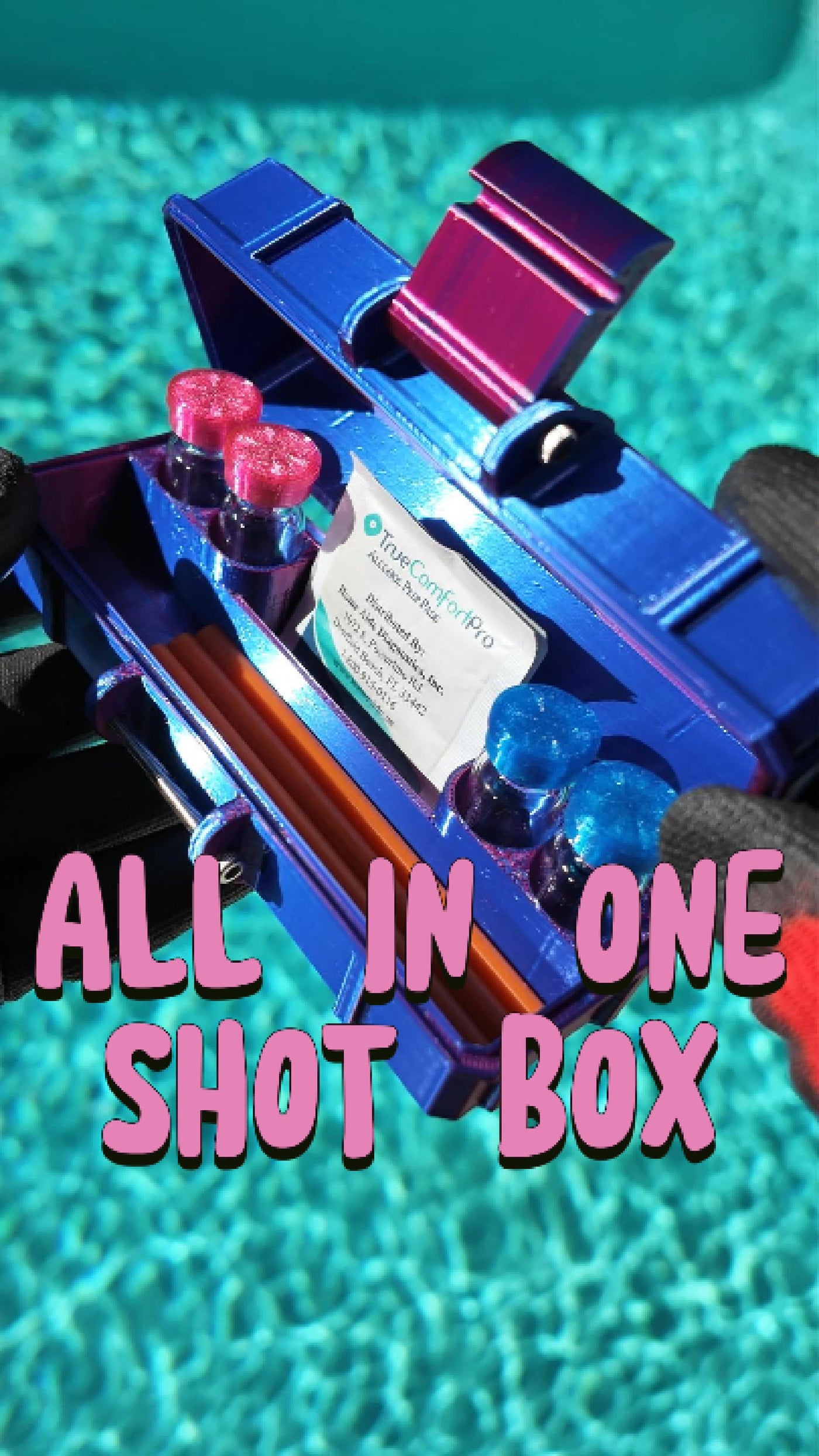
20-Slot 3 mL Vial Case with Syringe Storage — designed for 4–10 day Disney trips with multiple peptide vials, syringes, and BAC water in one organized unit. Shop Now →
FAQ
Does Walt Disney World allow guests to bring GLP-1 medications into the parks?
Yes. Disney's documented bag policy permits prescription medications including injectable GLP-1s, peptide vials, BAC water, syringes, and cold packs. Original packaging or prescription documentation supports faster security screening at the park entrance.
Can Disney First Aid Centers store my Ozempic or Wegovy during the day?
Yes. Each of the four park First Aid Centers documents refrigerated medication storage as a free service. The same applies at the two water park First Aid Centers. Cast Members do not document requiring proof of medical need.
Are Disney resort hotel mini-fridges suitable for GLP-1 storage?
Yes. All Disney-owned resort hotel rooms include an in-room refrigerator documented as suitable for personal use including short-term medication cooling. The unit is not pharmaceutical-grade. For temperature-critical compounded medications, hotel concierge can arrange access to property pharmacy or First Aid services.
Can I leave my medication in a stroller during a Disney park day?
Documented practice is acceptable when the stroller is parked in shade and the medication is in an insulated case with cold packs. Direct sun on a stroller in central Florida summer can routinely push interior temperatures above the 86°F (30°C) ceiling for branded GLP-1s. Documented best practice for hot-weather days is using First Aid refrigeration during ride sessions and retrieving the medication at the end of the day.
What happens if I need to dispose of pen needles in the parks?
Disney's First Aid Centers document sharps disposal as a free service. Hotel housekeeping also documents accommodation for sharps disposal in resort rooms. Used pen needles are documented as items belonging in sharps containers rather than standard waste.
Trademark notice: Walt Disney World®, Walt Disney World Resort®, Magic Kingdom®, EPCOT®, Disney's Hollywood Studios®, Disney's Animal Kingdom®, Typhoon Lagoon®, Blizzard Beach®, Disney Springs®, Disability Access Service®, Disney Vacation Club®, MagicBand®, Genie+®, and Lightning Lane are trademarks of Disney Enterprises, Inc. and its affiliates. Ozempic® and Wegovy® are registered trademarks of Novo Nordisk A/S. Mounjaro® and Zepbound® are registered trademarks of Eli Lilly and Company. Vialcase is independent and is not affiliated with, endorsed by, or sponsored by The Walt Disney Company, Disney Enterprises, Inc., Novo Nordisk, or Eli Lilly. References are descriptive of publicly available park documentation and manufacturer prescribing information.
Recommended Theme Park Travel Cases
Vialcase produces hard-shell vial cases sized for theme park day-bag carry-on, with slots for GLP-1 pens, peptide vials, BAC water bottles, and the syringes and alcohol pads in a typical reconstitution kit. Three options most commonly referenced for park days:


Browse all vial storage cases →
Disclaimer
This article is informational reference only on documented Walt Disney World policies for medical accommodations and the documented storage profile for GLP-1 medications. It is not medical or legal guidance and does not direct any specific clinical action. Verify current policy details directly with Walt Disney World Resort and refer to manufacturer prescribing information and a licensed healthcare provider for clinical guidance.
Find your perfect case
Hard-shell, dust-free storage for every vial size. Made to order and backed by our 30-day guarantee.
Shop All Cases →