Hawaii with GLP-1 & Peptides: Oahu, Maui, Big Island, Kauai Reference (2026)
Updated on: 2026-05-08
Table of Contents
🧮 Plan dose dates around your Hawaii trip
Hawaii trips often span 7–14+ days. The free GLP1 Calculator's Titration Schedule maps weekly doses across your itinerary — useful for tracking time-zone shift impact.
📈 Track your weekly doses across the trip
The free GLP-1 Plotter logs each dose date and builds a plasma-level curve — useful for visualizing where each injection falls during your trip and confirming you don't miss a week.
- Hawaii tropical climate profile
- Oahu (Honolulu, Waikiki, North Shore)
- Maui (Lahaina, Wailea, Kihei, Hana)
- Big Island (Kona, Hilo, Volcanoes)
- Kauai (Princeville, Poipu, Lihue)
- Mainland-to-Hawaii flight logistics
- Inter-island travel
- Hawaii agricultural inspection
- Beach/pool day medication storage
- FAQ
- Disclaimer
1) Hawaii tropical climate profile
Hawaii's tropical climate is documented as remarkably consistent year-round:
- Daily highs — 75–88°F (24–31°C) year-round at sea level. Trade winds moderate the temperature.
- Direct sun on beach/pool — documented effective temperature 90–100°F+ on sand and concrete.
- Higher elevations (Haleakala on Maui, Mauna Kea on Big Island) — documented as substantially cooler; can drop below freezing at summit.
- Humidity — 60–80% typical; especially humid on windward sides of islands.
- No documented summer-vs-winter extreme — the consistent warm climate means medication storage planning is the same year-round.
Hawaii is documented as the most temperature-stable U.S. state for GLP-1 storage. Daily highs rarely exceed the 86°F (30°C) ceiling for branded GLP-1 storage when shaded; direct beach sun does push internal day-bag temperatures higher.
2) Oahu (Honolulu, Waikiki, North Shore)
- Honolulu/Waikiki hotels (Halekulani, Royal Hawaiian, Moana Surfrider, Kahala, Hilton Hawaiian Village, Marriott Waikiki, Hyatt Regency, Trump Waikiki) — document standard in-room refrigerators.
- North Shore lodging (Turtle Bay Resort) — documented standard refrigerators.
- Honolulu (HNL) Airport — primary Hawaii international gateway. Documented TSA standard medical-exemption protocols; lounge refrigeration access at major airline lounges.
- Pearl Harbor visit — outdoor memorial; documented practice is leaving medication in shaded bag or vehicle (with AC running) during the visit.
- Diamond Head hike — ~1.5 hour outdoor activity; documented practice is insulated case for hike duration.
3) Maui (Lahaina, Wailea, Kihei, Hana)
- Wailea/Makena luxury resorts (Four Seasons Wailea, Andaz Maui, Grand Wailea, Fairmont Kea Lani, Wailea Beach Resort) — document standard in-room refrigerators.
- Lahaina/Kaanapali resorts (Hyatt Regency, Sheraton, Westin, Marriott, Kaanapali Beach) — document standard refrigerators.
- Kihei vacation rentals/condos — full kitchens with refrigerators standard.
- Hana (East Maui) — remote; lodging includes Travaasa Hana with documented refrigerators. Drive to Hana documents 2–3 hour scenic outdoor exposure.
- Maui (OGG/Kahului) Airport — smaller than HNL; documented standard TSA protocols.
- Haleakala summit (10,023 ft) — documented temperatures 30–55°F at summit; significantly cooler than sea level.
4) Big Island (Kona, Hilo, Volcanoes)
- Kona-Kohala Coast luxury resorts (Four Seasons Hualalai, Mauna Kea Beach, Mauna Lani, Westin Hapuna, Fairmont Orchid) — document standard in-room refrigerators.
- Hilo (east side, wet/rainforest) — smaller hotel scene; Naniloa Hilo, Hilo Hawaiian Hotel.
- Volcanoes National Park — documented as high-elevation (~4,000 ft) with cooler temperatures than coastal Big Island. Volcano House lodge documents standard refrigerators.
- Kona (KOA) Airport — primary Big Island gateway. Hilo (ITO) Airport secondary.
- Mauna Kea summit visits (13,803 ft) — documented temperatures below freezing year-round at summit. Documented practice references not bringing medication on summit visits due to extreme conditions.
5) Kauai (Princeville, Poipu, Lihue)
- Princeville (north shore) — 1 Hotel Hanalei Bay, St. Regis Princeville (closed/transitioning) — document standard refrigerators when operational.
- Poipu (south shore) — Grand Hyatt Kauai, Sheraton Kauai — document standard refrigerators.
- Lihue (central) — Marriott Beach Club, Royal Sonesta Kauai — document standard refrigerators.
- Lihue (LIH) Airport — primary Kauai gateway.
- Na Pali Coast helicopter tours — documented as 1–2 hour outdoor activities; medication typically left at hotel.
6) Mainland-to-Hawaii flight logistics
- U.S. West Coast to HNL — ~5–6 hours; LAX, SFO, SEA, PDX as common gateways. Cabin temperature documented within range; cold packs cover transit time comfortably.
- U.S. East Coast to HNL — typically connects through LAX or SFO; total travel time 11–14 hours including connection.
- Time zone shift — Hawaii is Hawaii-Aleutian Time (UTC-10), 5 hours behind East Coast / 2 hours behind Pacific. Documented practice for once-weekly GLP-1 dose timing is keeping the same calendar day; small time-zone shift has minimal pharmacological effect.
- Hawaiian Airlines, Alaska, United, Delta, American — all serve mainland-Hawaii routes with documented standard medical-exemption protocols.
7) Inter-island travel
- Hawaiian Airlines, Southwest — primary inter-island carriers. ~30–45 minute flights between major islands.
- TSA at inter-island — same medical-exemption framework as mainland flights.
- Day-trip considerations — documented practice for inter-island day-trips is keeping medication at base hotel rather than carrying for the day.
8) Hawaii agricultural inspection
Hawaii is part of the U.S. but operates a state agricultural inspection program due to invasive-species concerns:
- Inbound agricultural inspection — applied to fresh produce, plants, and animal products. Documented as not applicable to prescription medications including GLP-1s, peptide vials, or BAC water.
- Outbound agricultural inspection — mandatory for departures from Hawaii to mainland U.S. Documented as focused on plants, fruits, and produce; prescription medications are documented as not subject to agricultural inspection.
- Cold packs — gel cold packs documented as not in scope of agricultural inspection. Frozen ice may be subject to scrutiny if visibly contaminated; gel packs are documented as routine for medical exemption.
9) Beach/pool day medication storage
Hawaii's beach culture documents specific medication storage challenges:
- Direct-sun beach storage — documented practice strongly references against leaving medication on sand or in non-shaded areas. Internal bag temperatures in direct Hawaiian sun can exceed 110°F (43°C).
- Beach umbrella shade — documented as reducing internal bag temperature substantially; insulated case in shade typically maintains medication temperature.
- Hotel pool — documented practice is leaving medication in hotel room mini-fridge during pool time and returning for dose timing as needed.
- Cabana rentals — many Hawaiian resort pools and beach clubs document cabana rentals with shade and lockable storage.
- Snorkeling/water sports — documented practice is leaving medication at hotel; not feasible to bring to in-water activities.
10) FAQ
Is Hawaii a TSA medical-exemption destination?
Yes. Hawaii is part of the U.S.; TSA's medical-medication exemption applies on flights to and from Hawaii. Original packaging and prescription documentation are documented standard.
Are Hawaiian resort hotel mini-fridges suitable for GLP-1 storage?
Yes. Major Hawaiian resort hotels (Four Seasons, Hyatt, Marriott, Hilton, Westin, Sheraton, Halekulani, Royal Hawaiian, Moana Surfrider) document standard in-room refrigerators suitable for the 2–8°C range needed for branded GLP-1 storage.
Does Hawaii's agricultural inspection affect prescription medication?
No. Hawaii's agricultural inspection focuses on plants, produce, and animal products. Prescription medications including GLP-1s, peptide vials, and BAC water are documented as not in scope. Cold packs (gel) are documented as routine.
How does Hawaii's tropical climate affect GLP-1 storage compared to mainland?
Hawaii's daily highs (75–88°F year-round) are documented as more consistent than mainland summer/winter swings. Resort hotel refrigerators provide reliable storage. Beach and pool days require active cooling; hotel-based storage is documented as standard practice.
What about time zone shift for once-weekly GLP-1 dosing?
Hawaii is 2–5 hours behind mainland U.S. The 5-day half-life of semaglutide and tirzepatide means small time-zone shifts have minimal pharmacological effect. Documented practice is keeping the same calendar day for dosing.
Trademark notice: Ozempic®, Wegovy®, Mounjaro®, and Zepbound® are registered trademarks of Novo Nordisk A/S and Eli Lilly and Company. Hawaiian Airlines®, Halekulani®, Royal Hawaiian®, Moana Surfrider®, Four Seasons®, Grand Hyatt Kauai®, and named Hawaiian resorts are registered trademarks of their respective owners. Hawaii state agencies (Hawaii Department of Agriculture) are referenced descriptively. Vialcase is independent and is not affiliated with any of the entities referenced.
Recommended Travel Cases
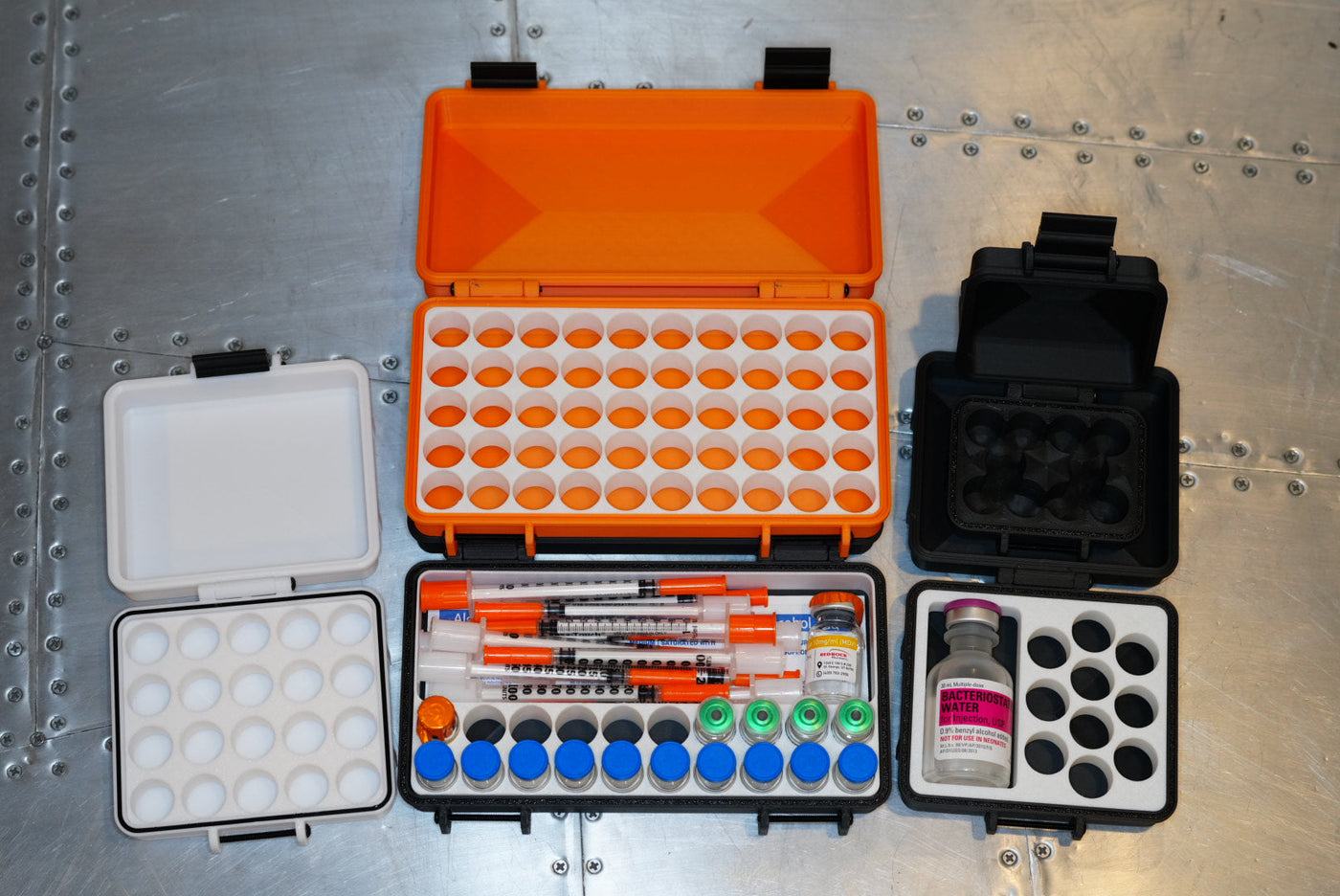
Vialcase produces hard-shell vial cases for GLP-1 pens, peptide vials, BAC water bottles, and reconstitution supplies.


Browse all vial storage cases →
Disclaimer
This article is informational reference only on documented Hawaii travel considerations. It is not medical or legal advice. Refer to manufacturer prescribing information and a licensed healthcare provider for clinical guidance.
Find your perfect case
Hard-shell, dust-free storage for every vial size. Made to order and backed by our 30-day guarantee.
Shop All Cases →