Japan with GLP-1 & Peptides: Yakkan Shoumei, MHLW Framework, Hotels, and Shinkansen (2026)
Updated on: 2026-05-08
Table of Contents
🧮 Plan dose dates around your Japan trip
Japan trips often span 7–14+ days. The free GLP1 Calculator's Titration Schedule maps weekly doses across your itinerary — useful for visualizing dose count for Yakkan Shoumei threshold determination.
📈 Track your weekly doses across the trip
The free GLP-1 Plotter logs each dose date and builds a plasma-level curve — useful for visualizing where each injection falls during your trip and confirming you don't miss a week.
- Japanese MHLW personal-use framework
- Yakkan Shoumei import certificate
- Major Japanese airports (HND, NRT, KIX, NGO)
- Japanese hotel mini-fridge profile
- Japanese climate by region
- Shinkansen (bullet train) travel
- Japanese pharmacy access
- Cherry blossom season and Golden Week considerations
- FAQ
- Disclaimer
1) Japanese MHLW personal-use framework
The Ministry of Health, Labour and Welfare (MHLW) governs medication import in Japan. Documented framework for personal-use prescription medications:
- 1-month supply or less — documented as permitted entry with original packaging and prescription documentation. No additional permits required.
- 1–2 month supply — documented as requiring a Yakkan Shoumei (import certificate) for some prescription categories. GLP-1 medications fall within the prescription-injectable category that often requires Yakkan Shoumei beyond 1 month.
- Beyond 2 months — documented as requiring import permission and stricter documentation.
- Original packaging — documented as required for personal-use carriage. Loose vials or non-original packaging is documented as more likely to trigger customs inspection.
2) Yakkan Shoumei import certificate
The Yakkan Shoumei is the Japanese import certificate documented for medications brought into Japan beyond the 1-month personal-supply threshold:
- Application process — documented as submitted to the MHLW Pharmaceutical and Medical Devices Agency (PMDA) ahead of travel. Application form, prescription, English-Japanese translation may be required.
- Processing time — documented as 2–4 weeks typically. Travelers planning Japan trips with extended GLP-1 supply needs are documented as initiating the application 4–6 weeks ahead of travel.
- Carry the certificate — the printed Yakkan Shoumei document is presented at Japanese customs along with the medication.
- For typical 7–14 day Japan trips — 1–3 weekly doses of GLP-1 are within the 1-month personal-supply threshold and typically don't require the Yakkan Shoumei.
- For longer trips or larger supply — the Yakkan Shoumei or alternative arrangements (Japanese pharmacy refill, mid-trip pharmacy supply) become relevant.
3) Major Japanese airports (HND, NRT, KIX, NGO)
- Tokyo Haneda (HND) — Tokyo's primary international airport (closer to central Tokyo than Narita). Documented MHLW-aware customs; English-language documentation accepted.
- Tokyo Narita (NRT) — secondary Tokyo international airport (~60 km from central Tokyo). Same MHLW framework.
- Osaka Kansai (KIX) — Osaka international gateway.
- Nagoya (NGO) — central Japan international airport.
- Other — Sapporo (CTS), Fukuoka (FUK), Naha Okinawa (OKA). All document standard MHLW protocols.
4) Japanese hotel mini-fridge profile
Japanese hotel mini-fridge availability:
- Western luxury chains in Japan (Park Hyatt, Mandarin Oriental, Aman, Ritz-Carlton, Four Seasons, Conrad, Peninsula) — document standard refrigerators in all categories.
- Japanese luxury hotels (Hoshinoya, The Okura, Imperial, New Otani, Hotel Okura) — document standard refrigerators.
- Japanese business hotels (APA, Toyoko Inn, Mitsui Garden, Daiwa Roynet, Comfort Hotel) — mini-fridges often standard but smaller than Western hotel norms; documented practice is confirming at booking.
- Ryokan (traditional inns) — refrigerator availability varies. Documented practice is confirming at booking when temperature-critical medication is involved. Some ryokan have shared refrigeration in the okami (host) area.
- Capsule hotels — do not document in-pod refrigeration; some have shared refrigeration at the front desk for guest medication.
5) Japanese climate by region
- Tokyo, Osaka, Kyoto — summer 80–92°F (27–33°C); humid (60–80% humidity). Heat index frequently exceeds 95°F (35°C). Spring/fall mild (60–75°F). Winter 35–50°F (2–10°C).
- Hokkaido (Sapporo) — cooler year-round. Summer 65–78°F (18–26°C). Winter heavy snow.
- Kyushu (Fukuoka) — subtropical southern Japan. Summer 85–92°F.
- Okinawa — tropical. Year-round warm; summer 85–90°F with high humidity.
Japanese summer heat (especially Tokyo, Osaka, Kyoto in July/August) routinely approaches the 86°F (30°C) ceiling for branded GLP-1 storage. Documented practice for summer Japan travel is hotel refrigerator confirmed and insulated case for sightseeing days.
6) Shinkansen (bullet train) travel
- No security screening for medication on Shinkansen. Carry-on is unrestricted.
- Climate-controlled cabin — Shinkansen cabins are documented as climate-controlled to ~24°C (75°F). Comfortable for medication carry.
- Common routes — Tokyo–Kyoto (2.5h), Tokyo–Osaka (3h), Tokyo–Hiroshima (4h), Tokyo–Hakata Fukuoka (5h).
- JR Pass — documented as available to international visitors for unlimited Shinkansen travel during the validity period. Useful for multi-city Japan itineraries.
7) Japanese pharmacy access
- Yakkyoku (drugstores) — widely distributed in Japanese cities. Major chains include Matsumoto Kiyoshi, Welcia, Sundrug, Cocokara Fine. Documented as primarily for OTC and minor needs; prescription medication availability varies.
- Hospital pharmacies — documented as the primary channel for prescription medication. International visitors typically require a Japanese physician consultation for prescription refills.
- English-speaking medical access — major Tokyo and Osaka hospitals document English-speaking staff. International SOS clinics and embassies maintain lists of English-speaking providers.
- Brand availability in Japan — Ozempic and Mounjaro are documented as available in Japan under their international brand names. Wegovy is approved in Japan as of 2024 with limited prescribing channels.
8) Cherry blossom season and Golden Week considerations
- Cherry blossom season (late March–early April) — documented as Japan's peak tourist period. Hotel availability is constrained and pricing is documented as highest of the year. Documented practice is booking 6–12 months ahead for cherry blossom trips.
- Golden Week (late April–early May) — documented as Japan's domestic-travel peak. Hotels, Shinkansen reservations, and tourist attractions document high crowding. International travelers visiting during Golden Week may find limited availability.
- Climate during these seasons — cherry blossom and Golden Week document mild spring weather (55���72°F / 13–22°C). Highly favorable for medication carry.
9) FAQ
Do I need a Yakkan Shoumei to bring my GLP-1 to Japan?
For typical 7–14 day Japan trips, weekly GLP-1 medications fall within the 1-month personal-supply threshold and typically don't require a Yakkan Shoumei. For longer trips (3+ weeks) or extended supply (2+ months), the Yakkan Shoumei is documented as the standard import certificate. Documented practice is checking with the Japanese MHLW PMDA ahead of travel for case-specific guidance.
How do I apply for a Yakkan Shoumei?
The Yakkan Shoumei application is documented as submitted to the MHLW Pharmaceutical and Medical Devices Agency (PMDA) via fax or email; processing time is documented as 2–4 weeks. Documented practice is initiating the application 4–6 weeks ahead of travel.
Can I refill my GLP-1 prescription in Japan?
Japanese prescription medication access for international visitors is documented as requiring a Japanese physician consultation. Major Tokyo and Osaka hospitals document English-speaking providers. Documented practice is bringing the trip's full supply plus margin rather than relying on Japanese pharmacy refill.
Are Japanese hotel mini-fridges suitable for GLP-1 storage?
Western chain luxury hotels (Park Hyatt, Mandarin Oriental, Conrad, Peninsula) and Japanese luxury hotels (Imperial, Okura, New Otani) document standard in-room refrigerators. Japanese business hotels and ryokan vary; documented practice is confirming at booking.
How does Japanese summer humidity affect medication storage?
Japanese summer humidity (60–80%) is documented as not directly affecting GLP-1 storage profile (storage is governed by temperature). Documented practice is treating summer Japan like other hot regions — hotel refrigerator primary, insulated case for sightseeing.
Trademark notice: Ozempic®, Wegovy®, Mounjaro®, and Zepbound® are registered trademarks of Novo Nordisk A/S and Eli Lilly and Company. Shinkansen® and JR Pass® are registered trademarks of Japan Railways Group. Park Hyatt®, Mandarin Oriental®, Conrad®, Peninsula®, Aman®, Ritz-Carlton®, Four Seasons®, Hoshinoya®, Okura®, Imperial Hotel®, and New Otani® are registered trademarks of their respective owners. MHLW (Ministry of Health, Labour and Welfare) and PMDA (Pharmaceutical and Medical Devices Agency) are Japanese government entities. Vialcase is independent and is not affiliated with any of the entities referenced.
Recommended Travel Cases
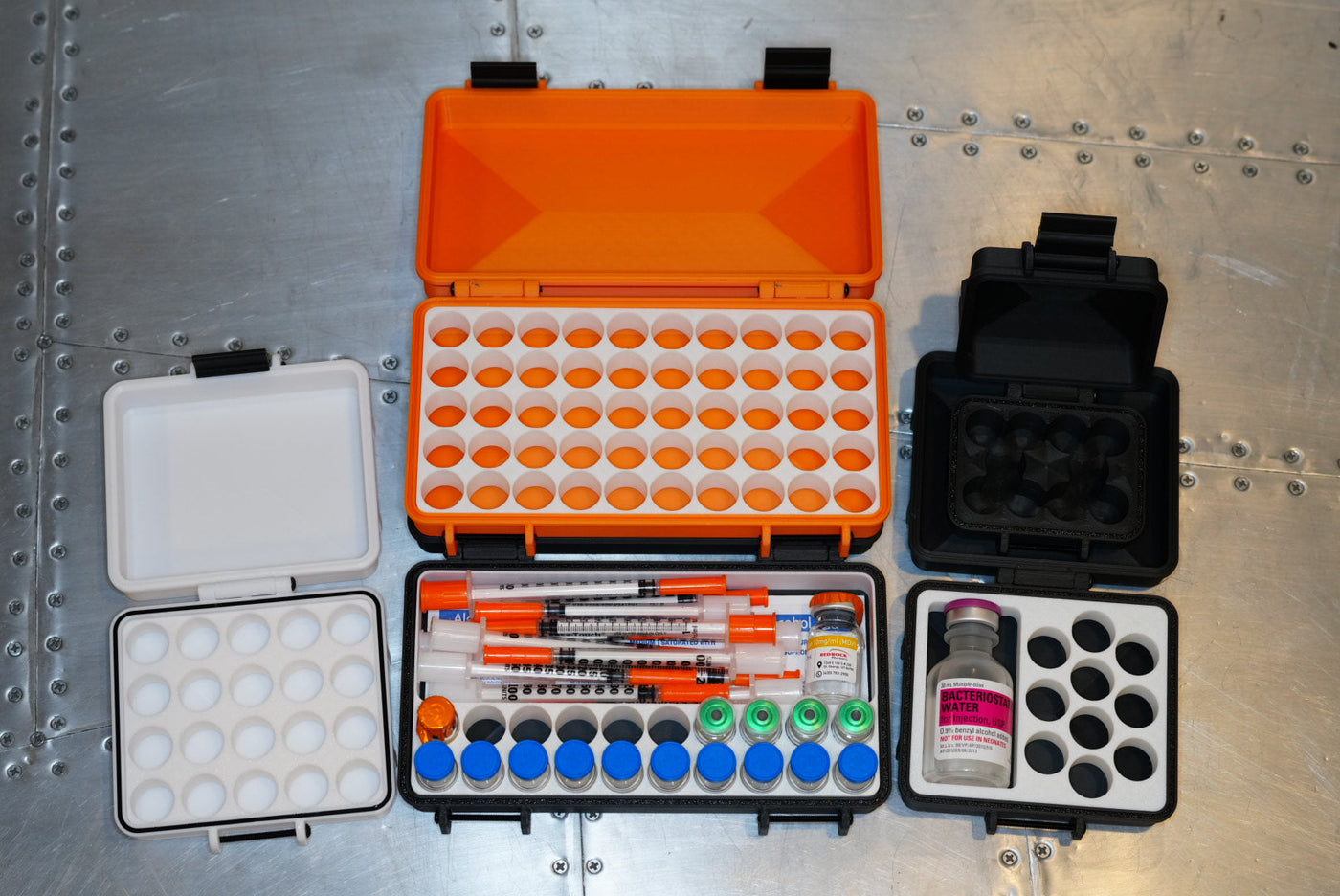
Vialcase produces hard-shell vial cases sized for GLP-1 pens, peptide vials, BAC water bottles, and reconstitution supplies. Three options most commonly referenced for travel:


Browse all vial storage cases →
Disclaimer
This article is informational reference only on documented Japan travel considerations. It is not medical or legal advice. Refer to current MHLW PMDA guidance, the Yakkan Shoumei official application process, and a licensed healthcare provider for clinical guidance.
Find your perfect case
Hard-shell, dust-free storage for every vial size. Made to order and backed by our 30-day guarantee.
Shop All Cases →